
|
Killing Children & Parents
through psychological abuse, It's what the APA does best! |
|
The people listed below are child abusers. They work at or were presidents of the APA. Each person listed below has emphatically stated "It is OK to abuse and murder children and parents from these methods!" Child Psychological Abuse DSM-5 V995.51 Spouse or partner abuse Psychological DSM-5 V995.82 Delusional Disorder - Persecutory type (Shared) DSM-5 297.1 Factious Disorder imposed on another DSM-5 300.19 |
|
|
Kim Mills (Kills) [email protected]
|
Rob Fredley [email protected][email protected]
|

|

|
APA's past Presidents & Child abusers
|
2017 Antonio Puente [email protected]

2018 Jessica Henderson Daniel [email protected]

2019 Rosie Phillips Bingham

|
2020 Sandra L. Shullman [email protected]

2022 Jennifer F. Kelly

2022 Frank C. Worrell [email protected]

2023 Thema S. Bryant [email protected]

|
Please, let the APA know that Alienated Parents exist by leaving a review of the APA HERE.
Here is the latest email with the current APA president: Cynthia De La Fuentes, Sent May 11th 2024
Dear Cynthia De La Fuentes,
I first would like to apologize for not contacting you earlier.
I have reached out to all of the APA presidents for the last 8 years, since Antonio Puente.
I have had the misfortune of watching my 3 daughters psychologically abused right in front of me and now it has been 10+ years of having zero contact with any of them.
This trauma has caused me to be an advocate to prevent this kind of child psychological trauma to other children and their parents. Predominantly within family court.
So while this letter is from me it has the backing of tens of thousands of parents and their children.
The issue at hand:
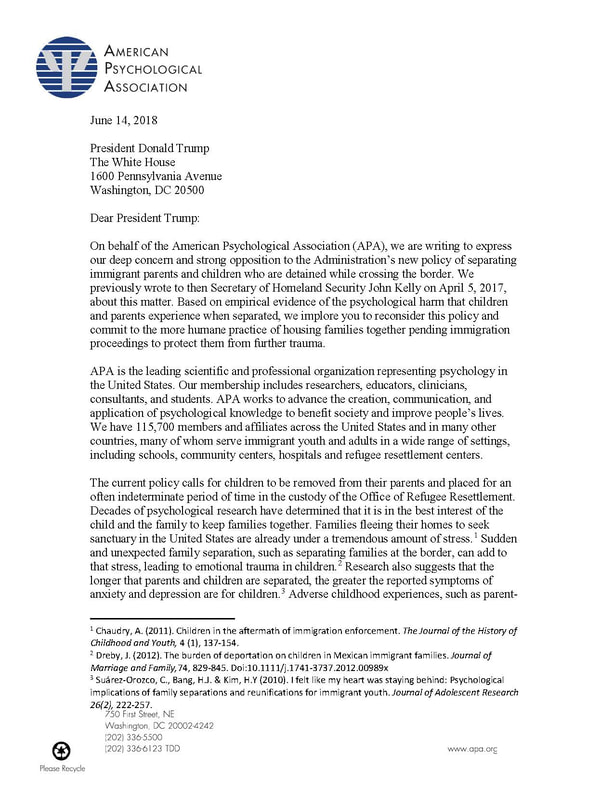
The Apa wrote a letter to the President of the United States on June 14th, 2018,
It went into many key points about why the separation of parents and children was so damaging psychologically and emotionally. It brought key factors of empirical data and decades of experience.
I wrote a follow-up email to Dr. Jessica Daniel in June of 2018 comparing the APA's letter to the separation of children and parents in the family courts.
I have attached both of the letters for you to read.
I am honestly trying to figure out why the APA has acted the way they have acted:
The APA has refused to protect people from harm
The APA has refused to maintain competence
The APA has practiced out of their field of expertise
and more.
I am not trying to firehose you with information.
But, unfortunately, I have watched hundreds of parents commit suicide, spoken with parents whose child has committed suicide, and listened to thousands of parents cry and be destroyed from this devastation.
The APA knows this because they wrote about it in their letter 2018. 3rd paragraph, "a man from Honduras that hung himself"
The main issues I am talking about are:
Child Psychological Abuse DSM-5 V995.51 'ordered by judges'
Spouse or partner abuse Psychological DSM-5 V995.82 'ordered by judges'
Delusional Disorder - Persecutory type (Shared) DSM-5 297.1 'ordered by judges'
Factious Disorder imposed on another DSM-5 300.19 'ordered by judges'
Let's please face the facts. You are the sitting president of the APA and if you are not a specialist in these disorders then you know someone who is. Also, you specialize in these:
The highlighted ones are directly affected (can be caused) by the abovementioned issues.
I am really tired of getting the silent treatment and being ignored by the APA. More importantly, I am appalled that the self-proclaimed leader of the psychological association continues to be complicit in child abuse and murder.
Please note: I have contacted Kim Mills many times over 7 years, and she has done her best to advocate for the APA and herself that all issues in blue DO NOT EXIST. She will not discuss them, refuses to have a clinical psychologist who is an expert in these fields on the APA's podcast discuss them. Kim Mills has played a giant part in the murder and abuse of children and parents by her actions.
I ask that you address this letter ASAP. Just as in your 2018 letter, children and parents are being abused right now and some will commit suicide on Mother's Day and Father's Day.
Please let me know if you received this email and when to expect a response.
sincerely,
Kenneth R. Gottfried
GottfriedMarketing.com
(561) 662-2273
Dear Cynthia De La Fuentes,
I first would like to apologize for not contacting you earlier.
I have reached out to all of the APA presidents for the last 8 years, since Antonio Puente.
I have had the misfortune of watching my 3 daughters psychologically abused right in front of me and now it has been 10+ years of having zero contact with any of them.
This trauma has caused me to be an advocate to prevent this kind of child psychological trauma to other children and their parents. Predominantly within family court.
So while this letter is from me it has the backing of tens of thousands of parents and their children.
The issue at hand:
The Apa wrote a letter to the President of the United States on June 14th, 2018,
It went into many key points about why the separation of parents and children was so damaging psychologically and emotionally. It brought key factors of empirical data and decades of experience.
I wrote a follow-up email to Dr. Jessica Daniel in June of 2018 comparing the APA's letter to the separation of children and parents in the family courts.
I have attached both of the letters for you to read.
I am honestly trying to figure out why the APA has acted the way they have acted:
The APA has refused to protect people from harm
The APA has refused to maintain competence
The APA has practiced out of their field of expertise
and more.
I am not trying to firehose you with information.
But, unfortunately, I have watched hundreds of parents commit suicide, spoken with parents whose child has committed suicide, and listened to thousands of parents cry and be destroyed from this devastation.
The APA knows this because they wrote about it in their letter 2018. 3rd paragraph, "a man from Honduras that hung himself"
The main issues I am talking about are:
Child Psychological Abuse DSM-5 V995.51 'ordered by judges'
Spouse or partner abuse Psychological DSM-5 V995.82 'ordered by judges'
Delusional Disorder - Persecutory type (Shared) DSM-5 297.1 'ordered by judges'
Factious Disorder imposed on another DSM-5 300.19 'ordered by judges'
Let's please face the facts. You are the sitting president of the APA and if you are not a specialist in these disorders then you know someone who is. Also, you specialize in these:
The highlighted ones are directly affected (can be caused) by the abovementioned issues.
- Mood disorders, such as depression and bi-polar disorder
- Anxiety disorders, such as severe stress, post- traumatic stress, panic, and social phobias
- Obsessive Compulsive Disorders (OCD)
- Relationship issues, including pre-marital counseling and divorce
- Grief and loss
- Parent-child relationship problems
- Adoption
- Identity issues, including gender and sexual orientation, and ethnic and racial identities
- Problems in acculturation, culture shock, grief and loss of homeland, experiences of racism
- Multicultural psychology, Latinx psychology (I am fluent in Spanish)
- Gender issues, role strain, experiences of sexism
- Career, work, and education
I am really tired of getting the silent treatment and being ignored by the APA. More importantly, I am appalled that the self-proclaimed leader of the psychological association continues to be complicit in child abuse and murder.
Please note: I have contacted Kim Mills many times over 7 years, and she has done her best to advocate for the APA and herself that all issues in blue DO NOT EXIST. She will not discuss them, refuses to have a clinical psychologist who is an expert in these fields on the APA's podcast discuss them. Kim Mills has played a giant part in the murder and abuse of children and parents by her actions.
I ask that you address this letter ASAP. Just as in your 2018 letter, children and parents are being abused right now and some will commit suicide on Mother's Day and Father's Day.
Please let me know if you received this email and when to expect a response.
sincerely,
Kenneth R. Gottfried
GottfriedMarketing.com
(561) 662-2273
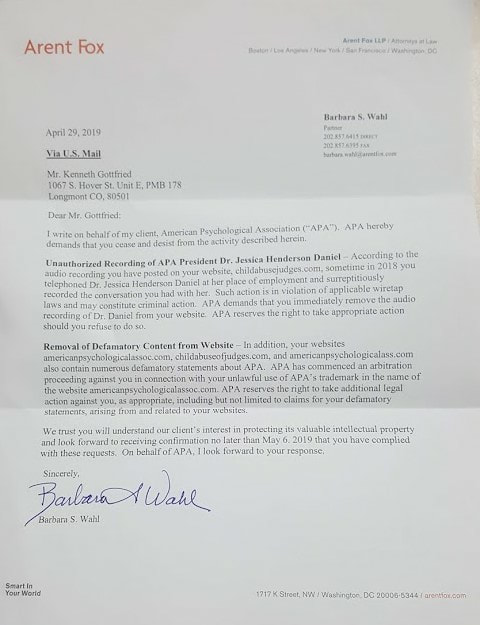
The American Psychological Association fights to cover-up child abuse and domestic violence causing the suicide of untold parents & children.
In a letter to Kenneth Gottfried dated Apr 19th, 2019, Lawfirm Arent Fox acknowledged the APA is completely aware of a special population being destroyed by domestic violence(IPV) and child abuse. The letter continues to confirm severe ethical violations of the APA and its presidents, board members in refusing to warn the public.
This extreme emotional child abuse and domestic violence has resulted the suicide of parents and children (Ref: Dr. Daniels 2018 letter & CDC-Kaiser Study). The abuses leave children with such emotional damage, a majority of them wind up with lifelong psychological issues such as splitting, borderline, narcissistic personality disorder, anxiety, depressions, suicidal ideation and more (Ref: Dr. Childress book Foundations, Dr Daniels letter to President Trump, Bowen, M. (1978). Family Therapy in Clinical Practice. New York: Jason Aronson, Titelman, P. (2003). Emotional cutoff: Bowen family systems theory perspectives. New York: Haworth Press, John Bowlby's three volume set on the attachment system Vol 1: Attachment, Vol 2: Separation - Anxiety & Anger, Vol 3: Loss - Sadness & Grief, Salvador Minuchin, triangulation, cross-generational coalition, emotional cutoff, Bowlby - Ainsworth - Fonagy - Handbook of Attachment, Bowen - Minuchin - Haley - Madanes - Beck - Kernberg - Millon - Linehan, van der Kolk - Perry).
The reference material is nothing new in psychology but actually the standards of psychology itself. These pillars are mandated learning by the APA's own code of ethics for anyone practicing in these fields.
The APA's tagline: "APA is the leading scientific and professional organization representing psychology in the United States.""APA works to advance the creation, communication, and application of psychological knowledge to benefit society and improve people’s lives." This statement is not only fraudulent but the APA put itself directly in the cross-hairs of a class action lawsuit. The hypocrisy of the APA seems to have no boundaries, when they proclaim to be leading and protecting, but from their actions there is literally a trail of dead bodies.
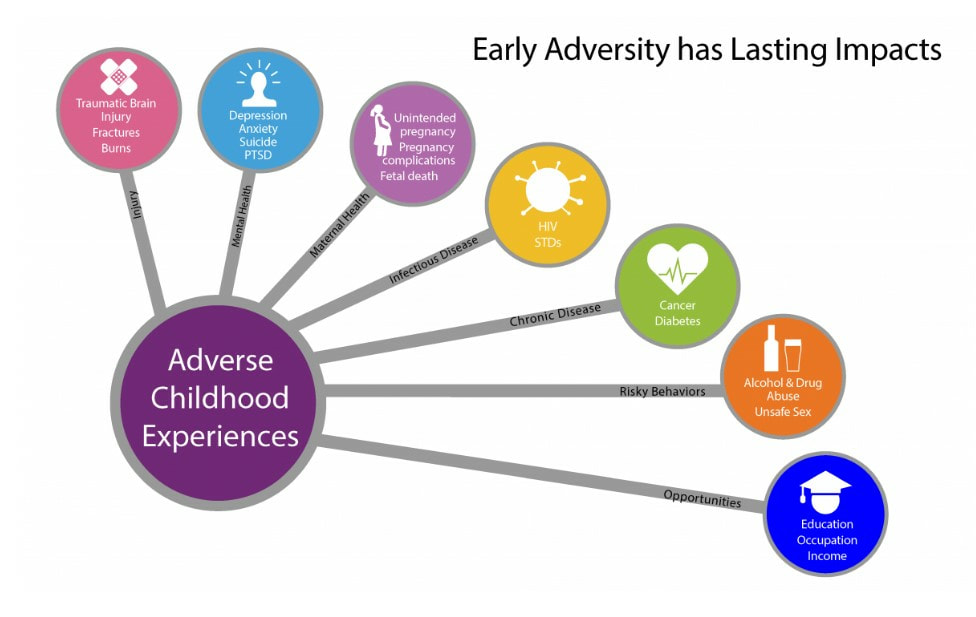
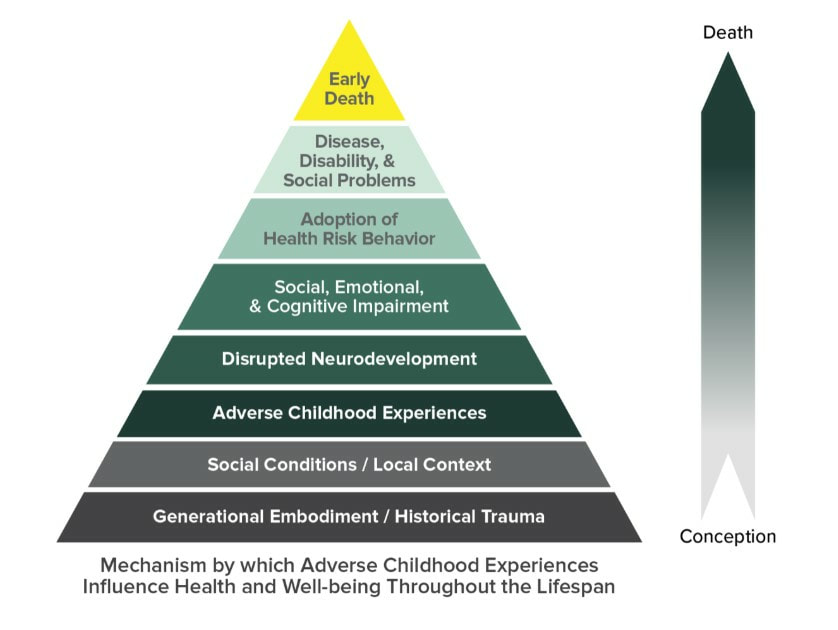
In the APA's own penmanship with a letter to President Donald Trump, the APA states unequivocally that they have decades of experience and empirical data that the separation of children and parents causes major trauma and higher ACE's (Adverse Childhood Experiences) Scores. The APA has made so many claims to be the "LEADING SCIENTIFIC ORGANIZATION" but in actuality have caused nightmares for families.
Since 2016 I have been in contact with the APA asking them questions about Attachment-Based Parental-Alienation, a severe form of emotional child abuse,(A term coined by Dr. Craig Childress) which describes precisely how a parent can manipulate a child as a weapon to erase a targeted parent. I received a plethora of misdirection, untrue statements, unanswered phone calls, messages & letters, from the past 3 presidents of the APA (2017, 2018, 2019). What I have not received from the self proclaimed "LEADING SCIENTIFIC ORGANIZATION", are answers, the truth, and their ethically obligated responsibility. You would expect when someone asks about Child Abuse and Domestic Violence that leads to suicide, a respectable, and responsible organization would at the very least answer the questions to why they are doing nothing.
The fact that the APA put together a letter to President Donald Trump in about 3 weeks about this exact issue (Separation of Parents and children) and the APA has been doing everything in its power to discourage anyone that has asked questions about the same subject regarding family court, is beyond the scope of my imagination to comprehend.
Please, let them know that we exist by leaving a review of the APA HERE.
Feel free to read the letters from the APA's Law Firm Arent Fox and Kenneth Gottfrieds response.
In a letter to Kenneth Gottfried dated Apr 19th, 2019, Lawfirm Arent Fox acknowledged the APA is completely aware of a special population being destroyed by domestic violence(IPV) and child abuse. The letter continues to confirm severe ethical violations of the APA and its presidents, board members in refusing to warn the public.
This extreme emotional child abuse and domestic violence has resulted the suicide of parents and children (Ref: Dr. Daniels 2018 letter & CDC-Kaiser Study). The abuses leave children with such emotional damage, a majority of them wind up with lifelong psychological issues such as splitting, borderline, narcissistic personality disorder, anxiety, depressions, suicidal ideation and more (Ref: Dr. Childress book Foundations, Dr Daniels letter to President Trump, Bowen, M. (1978). Family Therapy in Clinical Practice. New York: Jason Aronson, Titelman, P. (2003). Emotional cutoff: Bowen family systems theory perspectives. New York: Haworth Press, John Bowlby's three volume set on the attachment system Vol 1: Attachment, Vol 2: Separation - Anxiety & Anger, Vol 3: Loss - Sadness & Grief, Salvador Minuchin, triangulation, cross-generational coalition, emotional cutoff, Bowlby - Ainsworth - Fonagy - Handbook of Attachment, Bowen - Minuchin - Haley - Madanes - Beck - Kernberg - Millon - Linehan, van der Kolk - Perry).
The reference material is nothing new in psychology but actually the standards of psychology itself. These pillars are mandated learning by the APA's own code of ethics for anyone practicing in these fields.
The APA's tagline: "APA is the leading scientific and professional organization representing psychology in the United States.""APA works to advance the creation, communication, and application of psychological knowledge to benefit society and improve people’s lives." This statement is not only fraudulent but the APA put itself directly in the cross-hairs of a class action lawsuit. The hypocrisy of the APA seems to have no boundaries, when they proclaim to be leading and protecting, but from their actions there is literally a trail of dead bodies.
In the APA's own penmanship with a letter to President Donald Trump, the APA states unequivocally that they have decades of experience and empirical data that the separation of children and parents causes major trauma and higher ACE's (Adverse Childhood Experiences) Scores. The APA has made so many claims to be the "LEADING SCIENTIFIC ORGANIZATION" but in actuality have caused nightmares for families.
Since 2016 I have been in contact with the APA asking them questions about Attachment-Based Parental-Alienation, a severe form of emotional child abuse,(A term coined by Dr. Craig Childress) which describes precisely how a parent can manipulate a child as a weapon to erase a targeted parent. I received a plethora of misdirection, untrue statements, unanswered phone calls, messages & letters, from the past 3 presidents of the APA (2017, 2018, 2019). What I have not received from the self proclaimed "LEADING SCIENTIFIC ORGANIZATION", are answers, the truth, and their ethically obligated responsibility. You would expect when someone asks about Child Abuse and Domestic Violence that leads to suicide, a respectable, and responsible organization would at the very least answer the questions to why they are doing nothing.
The fact that the APA put together a letter to President Donald Trump in about 3 weeks about this exact issue (Separation of Parents and children) and the APA has been doing everything in its power to discourage anyone that has asked questions about the same subject regarding family court, is beyond the scope of my imagination to comprehend.
Please, let them know that we exist by leaving a review of the APA HERE.
Feel free to read the letters from the APA's Law Firm Arent Fox and Kenneth Gottfrieds response.
|
|
Kenneth Gottfrieds Response to Arent Fox's letter:
Kenneth Gottfried 5/13/2019
1067 S. Hover St. Ste E 178
Longmont CO 80501
Arent Fox
1717 K. street, NW
Washington DC 20006-5344
Dear Barbara Wahl,
Thank you for your letter. While you look forward to my response, I continue to look forward to Dr. Danial’s response to my letter dated June 28th 2018. I spoke to her several times (as you already know) and she assured me she would send me a reply ASAP. She understood any delay in her/the APA’s response would cause imminent danger for those parents and children being separated by family court. (See both mine and Dr Daniel’s letters, attached)
Since it is obvious that you have gone over my websites hopefully in detail, please understand that your clients are in serious violation of their own statutes and code of ethics.
Standard 2.01a - Boundaries of Competence
Standard 9.01a - Competence in Assessment
Standard 3.04 - Avoiding Harm to the Client
Standard 2.03 - Maintaining Competence
Standard 4.05, Disclosures. Mandated to report child abuse + Most professionals who work with families and children are mandated by law All states require certain professionals or institutions to report suspected child abuse. Those required by law to file are considered mandated reporters. These professionals can include health care providers, mental health providers, crisis counselors, school personnel, social workers, day care providers and law enforcement personnel among others.
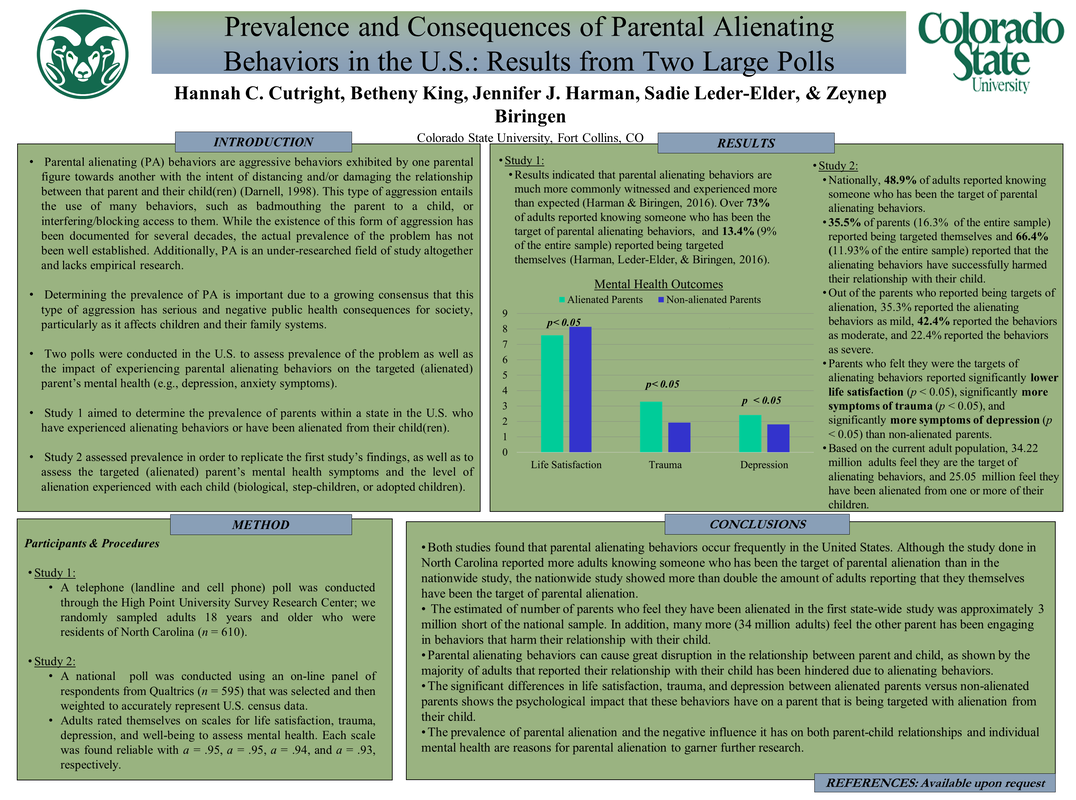
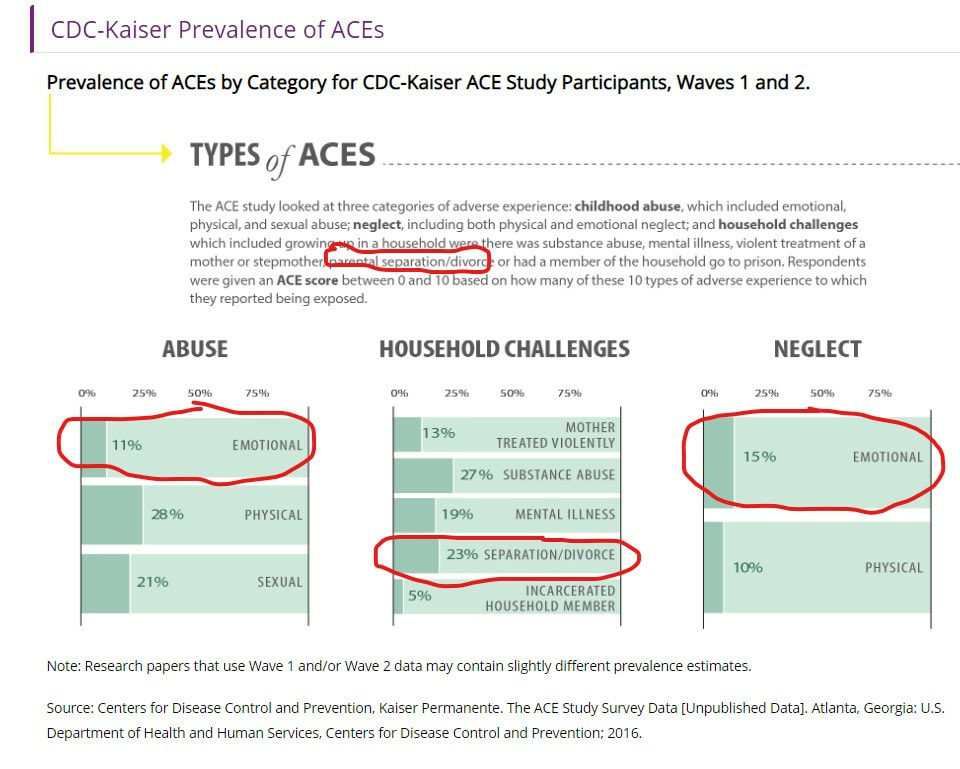
The APA’s conduct has directly ruined the lives and directly contributed in the suicide of countless children and parents. They are negligently and intentionally responsible for the increase of childhood trauma, increased ACE’s scores, resulting from the separation of parents and children by family court to the tune of 22+Million people. (See Jennifer Jill Harmon study attached, and the Kaiser Permanente/CDC study, One of the largest study’s in history. Slides attached and link https://www.cdc.gov/violenceprevention/childabuseandneglect/acestudy/ace-graphics.html ).
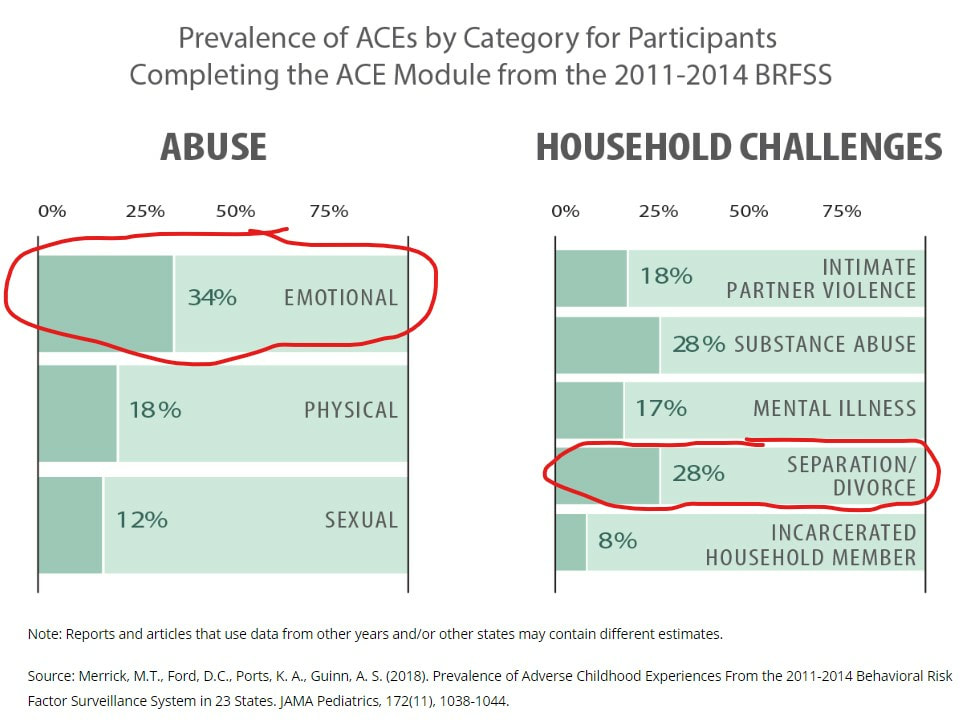
Please note that in slide 3 of the ACE’s scores that Emotional abuse is 38%. This percentage is higher than sexual and physical abuse combined. Also in slide 3, separation and divorce is as high as substance abuse at 28%. The fact that substance abuse and separation & divorce percentages are identical should be alarming.
This not me saying stating these dangers, but Dr. Jessica Daniel stating facts in her letter to president Donald Trump, and the CDC-Kaiser study. Attached.
I find it HORRIFYING that the APA would rather have this handled by attorneys rather than doing their ethically obligated responsibility to protect from harm Standard 3.04 - Avoiding Harm to the Client. Quote from Dr. Danial’s & the APA’s letter “APA works to advance the creation, communication, and application of psychological knowledge to benefit society and improve people’s lives.”
As far as everything on the websites AmericanPsychologicalAss.com & ChildAbusiveJudges.com, 100% of everything is true. There is not 1 iota of misinformation on them. I am sorry that the APA is loaded with child abusers acting in disgusting, abhorrent behavior, which causes lifelong emotional issues and suicide (See Dr. Danial’s letter attached & the CDC-Kaiser slides).
If this is what you call defamatory, I believe your definition of defamatory is not correct.
Definition: damaging the good reputation of someone; slanderous or libelous.
While you portray the APA as having a good reputation, I (and most everyone I know) see them as a murderous, trauma inducing, bunch of unethical individuals that couldn’t give a damn about children, parents or their own code of ethics, especially when it comes to themselves. (See my letter to Dr. Daniel’s letter and her failure to respond. Attached)
The APA has committed wire and mail fraud by the APA referring to itself as “the leading scientific and professional organization”, when they know for a fact, they are taking money on that false pretense. To call an organization that knowingly and willfully allows the annihilation of families as a direct result of their actions and misinformation is repulsive.
This is a pattern of criminal activity conducted by the APA, ignoring the pillars of psychology for its own identity politics and monetary gains.
They are well within the statutes of limitations to be prosecuted for domestic violence, emotional child abuse and murder. The APA has known of this abuse for decades and have been complicit and actively mislead everyone in the denial of its existence. The APA has used their position to cause a ‘second injury’ to people going through this trauma. (Not good to torture victims with Complex PTSD and tell them what they are seeing and feeling is not true).
Here is the exact definition of second injury:
Second injury and betrayal trauma is when the trauma victim discloses their abuse, they are not believed by the mental health professionals who should respond and should protect them - a second injury and a betrayal of the victim by the mental health professional.
The direct quote from Courtois and Ford is:
From Courtois & ford: "Another unfortunate reality concerning complex trauma is related to its interpersonal nature. The closer the relationship between the perpetrator(s) and the victim(s) and their group memberships (e.g., in a family, religion, gender, political party, institution, chain of command), the more likely they are to face conditions of divided loyalty. As a self-protective strategy, the group may coalesce around silencing, secrecy, and denial. As a result, victims do not receive the help they expect and need when the victimization is disclosed or otherwise exposed. This circumstance has been labeled the second injury (symnds, 1975) or betrayal trauma (DePrince & Freyd, 2007). A lack of response or protection - or victim blaming - is betrayal of the victim's trust and the helper's responsibility that can severely exacerbate traumatic victimization." (p. 18)
If you & the APA would like to discuss or mediate our differences in this matter, I will be more than agreeable to accommodate such.
If you choose not to, please let your clients know that I will be ecstatic to subpoena each one of them for depositions.
Please note: EVERY STATEMENT IN THIS LETTER IS BACKED UP BY DECADES OF EXPERIENCE AND empirical evidence supplied by Dr. Jessica Daniel & The APA in it’s letter to President Donald J. Trump and the CDC-Kaiser study (Attached)
You should also be aware of a petition signed by over 19,000 people, that was hand delivered on June 6th, 2018 to the APA by Dr. Craig Childress, Wendy Perry & Rod McCall that addresses this exact and extremely urgent matter. To my knowledge the APA has not addressed the petition. Once again, the APA is in violation of their own code of ethics.
Standard 2.01a - Boundaries of Competence
Standard 9.01a - Competence in Assessment
Standard 3.04 - Avoiding Harm to the Client
Standard 2.03 - Maintaining Competence
Standard 4.05, Disclosures. Mandated to report child abuse + Most professionals who work with families and children are mandated by lawAll states require certain professionals or institutions to report suspected child abuse. Those required by law to file are considered mandated reporters. These professionals can include health care providers, mental health providers, crisis counselors, school personnel, social workers, day care providers and law enforcement personnel among others.
You want to know what’s truly tragic? I have only started learning about this for 5+ years and the APA has been doing this their whole professional careers.
Once again, thank you for your communication and the confirmation that:
Thank you again for that acknowledgement.
Sincerely
Kenneth Gottfried
A father/parent that has not had time with children in 5.5 years.
As Bar members, you are required by law to report suspected child abuse. This is not ‘suspected’ child abuse but is actual proven child abuse described by Dr. Daniel and the APA’s letter to President Donald Trump. Failure to report child abuse can place your ability to practice law in jeopardy.
Until then: Please note: I have filed Bar association complaints against you & Arent Fox LLP for being involved with acknowledging /protecting/covering-up and failing to report this child abuse ring. RICO act: for violent crimes against children and parents.
Many victims of violent crimes experience post-traumatic stress disorder (PTSD). This condition can cause a number of emotional issues and can have a long-term impact on a crime victim’s mental health. (See Dr. Daniel’s Letter & the CDC-Kaiser ACE’s study)
cc: Federal Bureau investigation Washington DC 10001
cc: Every single family and their lawyer that I am aware of, that is or has been involved with family court. That had their relationship damaged with his or her children, all because the APA refuses to do their obligated ethical responsibility.
cc: The many parents and groups I am associated with.
cc: Approximately 150 people that have personally sent Dr. Daniel an email asking for her reply to my letter.
Link to Dr. Craig Childress’s Petition. (I really suggest you read it.)
https://www.change.org/p/the-american-psychological-association-ending-parental-alienation-pathology-for-all-children-everywhere?fbclid=IwAR2eHEQli0dqir4hKDEppjMxvNjOHUZsM3eBd6iMTWhE67eMior_UyRZiF0&use_react=false
Slides from the CDC-Kaiser Study
The CDC-Kaiser Permanente Adverse Childhood Experiences (ACE) Study is one of the largest investigations of childhood abuse and neglect and household challenges and later-life health and well-being.
The original ACE Study was conducted at Kaiser Permanente from 1995 to 1997 with two waves of data collection. Over 17,000 Health Maintenance Organization members from Southern California receiving physical exams completed confidential surveys regarding their childhood experiences and current health status and behaviors.
Kenneth Gottfried 5/13/2019
1067 S. Hover St. Ste E 178
Longmont CO 80501
Arent Fox
1717 K. street, NW
Washington DC 20006-5344
Dear Barbara Wahl,
Thank you for your letter. While you look forward to my response, I continue to look forward to Dr. Danial’s response to my letter dated June 28th 2018. I spoke to her several times (as you already know) and she assured me she would send me a reply ASAP. She understood any delay in her/the APA’s response would cause imminent danger for those parents and children being separated by family court. (See both mine and Dr Daniel’s letters, attached)
Since it is obvious that you have gone over my websites hopefully in detail, please understand that your clients are in serious violation of their own statutes and code of ethics.
Standard 2.01a - Boundaries of Competence
Standard 9.01a - Competence in Assessment
Standard 3.04 - Avoiding Harm to the Client
Standard 2.03 - Maintaining Competence
Standard 4.05, Disclosures. Mandated to report child abuse + Most professionals who work with families and children are mandated by law All states require certain professionals or institutions to report suspected child abuse. Those required by law to file are considered mandated reporters. These professionals can include health care providers, mental health providers, crisis counselors, school personnel, social workers, day care providers and law enforcement personnel among others.
The APA’s conduct has directly ruined the lives and directly contributed in the suicide of countless children and parents. They are negligently and intentionally responsible for the increase of childhood trauma, increased ACE’s scores, resulting from the separation of parents and children by family court to the tune of 22+Million people. (See Jennifer Jill Harmon study attached, and the Kaiser Permanente/CDC study, One of the largest study’s in history. Slides attached and link https://www.cdc.gov/violenceprevention/childabuseandneglect/acestudy/ace-graphics.html ).
Please note that in slide 3 of the ACE’s scores that Emotional abuse is 38%. This percentage is higher than sexual and physical abuse combined. Also in slide 3, separation and divorce is as high as substance abuse at 28%. The fact that substance abuse and separation & divorce percentages are identical should be alarming.
This not me saying stating these dangers, but Dr. Jessica Daniel stating facts in her letter to president Donald Trump, and the CDC-Kaiser study. Attached.
I find it HORRIFYING that the APA would rather have this handled by attorneys rather than doing their ethically obligated responsibility to protect from harm Standard 3.04 - Avoiding Harm to the Client. Quote from Dr. Danial’s & the APA’s letter “APA works to advance the creation, communication, and application of psychological knowledge to benefit society and improve people’s lives.”
As far as everything on the websites AmericanPsychologicalAss.com & ChildAbusiveJudges.com, 100% of everything is true. There is not 1 iota of misinformation on them. I am sorry that the APA is loaded with child abusers acting in disgusting, abhorrent behavior, which causes lifelong emotional issues and suicide (See Dr. Danial’s letter attached & the CDC-Kaiser slides).
If this is what you call defamatory, I believe your definition of defamatory is not correct.
Definition: damaging the good reputation of someone; slanderous or libelous.
While you portray the APA as having a good reputation, I (and most everyone I know) see them as a murderous, trauma inducing, bunch of unethical individuals that couldn’t give a damn about children, parents or their own code of ethics, especially when it comes to themselves. (See my letter to Dr. Daniel’s letter and her failure to respond. Attached)
The APA has committed wire and mail fraud by the APA referring to itself as “the leading scientific and professional organization”, when they know for a fact, they are taking money on that false pretense. To call an organization that knowingly and willfully allows the annihilation of families as a direct result of their actions and misinformation is repulsive.
This is a pattern of criminal activity conducted by the APA, ignoring the pillars of psychology for its own identity politics and monetary gains.
They are well within the statutes of limitations to be prosecuted for domestic violence, emotional child abuse and murder. The APA has known of this abuse for decades and have been complicit and actively mislead everyone in the denial of its existence. The APA has used their position to cause a ‘second injury’ to people going through this trauma. (Not good to torture victims with Complex PTSD and tell them what they are seeing and feeling is not true).
Here is the exact definition of second injury:
Second injury and betrayal trauma is when the trauma victim discloses their abuse, they are not believed by the mental health professionals who should respond and should protect them - a second injury and a betrayal of the victim by the mental health professional.
The direct quote from Courtois and Ford is:
From Courtois & ford: "Another unfortunate reality concerning complex trauma is related to its interpersonal nature. The closer the relationship between the perpetrator(s) and the victim(s) and their group memberships (e.g., in a family, religion, gender, political party, institution, chain of command), the more likely they are to face conditions of divided loyalty. As a self-protective strategy, the group may coalesce around silencing, secrecy, and denial. As a result, victims do not receive the help they expect and need when the victimization is disclosed or otherwise exposed. This circumstance has been labeled the second injury (symnds, 1975) or betrayal trauma (DePrince & Freyd, 2007). A lack of response or protection - or victim blaming - is betrayal of the victim's trust and the helper's responsibility that can severely exacerbate traumatic victimization." (p. 18)
If you & the APA would like to discuss or mediate our differences in this matter, I will be more than agreeable to accommodate such.
If you choose not to, please let your clients know that I will be ecstatic to subpoena each one of them for depositions.
Please note: EVERY STATEMENT IN THIS LETTER IS BACKED UP BY DECADES OF EXPERIENCE AND empirical evidence supplied by Dr. Jessica Daniel & The APA in it’s letter to President Donald J. Trump and the CDC-Kaiser study (Attached)
You should also be aware of a petition signed by over 19,000 people, that was hand delivered on June 6th, 2018 to the APA by Dr. Craig Childress, Wendy Perry & Rod McCall that addresses this exact and extremely urgent matter. To my knowledge the APA has not addressed the petition. Once again, the APA is in violation of their own code of ethics.
Standard 2.01a - Boundaries of Competence
Standard 9.01a - Competence in Assessment
Standard 3.04 - Avoiding Harm to the Client
Standard 2.03 - Maintaining Competence
Standard 4.05, Disclosures. Mandated to report child abuse + Most professionals who work with families and children are mandated by lawAll states require certain professionals or institutions to report suspected child abuse. Those required by law to file are considered mandated reporters. These professionals can include health care providers, mental health providers, crisis counselors, school personnel, social workers, day care providers and law enforcement personnel among others.
You want to know what’s truly tragic? I have only started learning about this for 5+ years and the APA has been doing this their whole professional careers.
Once again, thank you for your communication and the confirmation that:
- The APA is well aware of this matter.
- The APA is in violation of their own ethical code of conduct.
- The APA is completely negligent and aware that their direct actions have resulted in lifelong emotional/psychological issues, the destruction of lives, and has caused and is causing suicide in countless children, parents, & families
- The APA is Pro-Child-Abuse and Pro-Domestic-Violence.
Thank you again for that acknowledgement.
Sincerely
Kenneth Gottfried
A father/parent that has not had time with children in 5.5 years.
As Bar members, you are required by law to report suspected child abuse. This is not ‘suspected’ child abuse but is actual proven child abuse described by Dr. Daniel and the APA’s letter to President Donald Trump. Failure to report child abuse can place your ability to practice law in jeopardy.
Until then: Please note: I have filed Bar association complaints against you & Arent Fox LLP for being involved with acknowledging /protecting/covering-up and failing to report this child abuse ring. RICO act: for violent crimes against children and parents.
Many victims of violent crimes experience post-traumatic stress disorder (PTSD). This condition can cause a number of emotional issues and can have a long-term impact on a crime victim’s mental health. (See Dr. Daniel’s Letter & the CDC-Kaiser ACE’s study)
cc: Federal Bureau investigation Washington DC 10001
cc: Every single family and their lawyer that I am aware of, that is or has been involved with family court. That had their relationship damaged with his or her children, all because the APA refuses to do their obligated ethical responsibility.
cc: The many parents and groups I am associated with.
cc: Approximately 150 people that have personally sent Dr. Daniel an email asking for her reply to my letter.
Link to Dr. Craig Childress’s Petition. (I really suggest you read it.)
https://www.change.org/p/the-american-psychological-association-ending-parental-alienation-pathology-for-all-children-everywhere?fbclid=IwAR2eHEQli0dqir4hKDEppjMxvNjOHUZsM3eBd6iMTWhE67eMior_UyRZiF0&use_react=false
Slides from the CDC-Kaiser Study
The CDC-Kaiser Permanente Adverse Childhood Experiences (ACE) Study is one of the largest investigations of childhood abuse and neglect and household challenges and later-life health and well-being.
The original ACE Study was conducted at Kaiser Permanente from 1995 to 1997 with two waves of data collection. Over 17,000 Health Maintenance Organization members from Southern California receiving physical exams completed confidential surveys regarding their childhood experiences and current health status and behaviors.
Jun 28, 2018, 12:26 PM
Dear Dr. Daniel,
Urgent! Children are committing suicide.
I am now truly confused and was wondering if can clarify something very urgent for me.
In my last conversation with you May 24th 2018 you said that child separation, trauma, and child abuse was not your field of expertise. You asked me to contact Lauren Caldwell of the APA's Children Youth and Family division.
Since then, I was made aware of a letter from the APA signed by you, Dated June 14th 2018 that you sent to:
President Donald Trump
with copies sent to
U.S. Attorney General Jeff Sessions
U.S. Secretary of Homeland Security Kirstjen Nielsen. Letter Attached:
This letter goes into great detail about The APA's "deep concern and strong opposition to the Administration’s new policy of separating immigrant parents and children who are detained while crossing the border"
You started this letter off that you it was: "Based on empirical evidence of the psychological harm that children and parents experience when separated, we implore you to reconsider this policy and commit to the more humane practice of housing families together pending immigration proceedings to protect them from further trauma."
In paragraph 2 you continued about how vast the APA's diversity of knowledge is as a "scientific and professional organization"
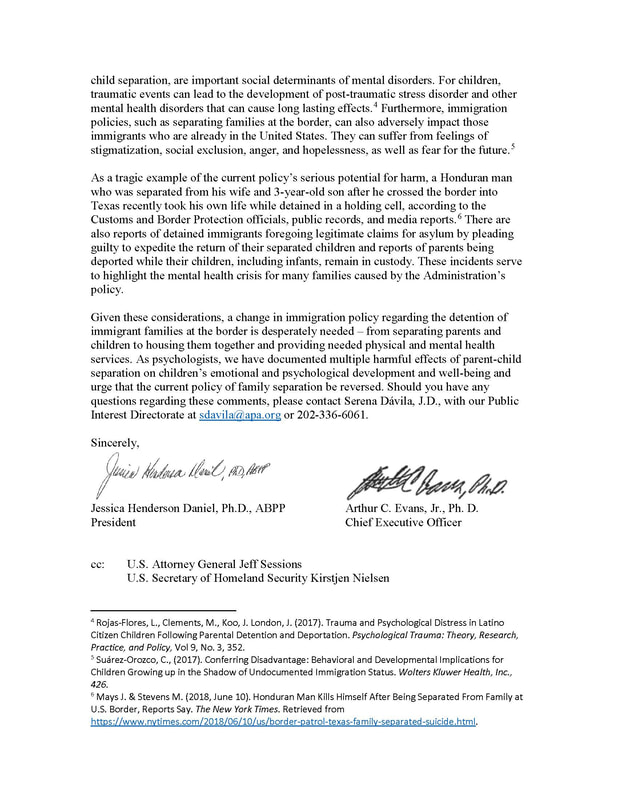
In paragraph 3 you explain "Decades of psychological research have determined that it is in the best interest of the child and the family to keep families together." "Sudden and unexpected family separation, such as separating families at the border, can add to that stress, leading to emotional trauma in children.2 Research also suggests that the longer that parents and children are separated, the greater the reported symptoms of anxiety and depression are for children. Adverse childhood experiences, such as parent-child separation, are important social determinants of mental disorders. For children, traumatic events can lead to the development of post-traumatic stress disorder and other mental health disorders that can cause long lasting effects.
In paragraph 5 you have an example of SUICIDE "As a tragic example of the current policy’s serious potential for harm, a Honduran man who was separated from his wife and 3-year-old son after he crossed the border into Texas recently took his own life while detained in a holding cell, according to the Customs and Border Protection officials, public records, and media reports.6 There are also reports of detained immigrants foregoing legitimate claims for asylum by pleading guilty to expedite the return of their separated children and reports of parents being deported while their children, including infants, remain in custody. These incidents serve to highlight the mental health crisis for many families caused by the Administration’s policy."
In your last paragraph you have summed up the desperate need for a change in policy with "we have documented multiple harmful effects of parent-child separation on children’s emotional and psychological development and well-being and urge that the current policy of family separation be reversed."
I have emailed you, Antonio Puente, Kim Mills, Jim Sliwa, Michael Shulman and many other members of the APA's board
I have been in contact since Oct 31, 2016.
I have asked many times about the forced separation of a parent and child by the family court system and it's lead to the Bowlby-Minuchin-Beck model of AB-PA. A special population.
Here is where I am at a serious dilemma, Either:
Please respond as:
Standard 1.05 If an apparent ethical violation has substantially harmed or is likely to substantially harm a person or organization and is not appropriate for informal resolution under Standard 1.04, Informal Resolution of Ethical Violations, or is not resolved properly in that fashion, psychologists take further action appropriate to the situation. Such action might include referral to state or national committees on professional ethics, to state licensing boards, or to the appropriate institutional authorities.
Standard 2.01a - Boundaries of Competence
Standard 9.01a - Competence in Assessment
Standard 3.04 - Avoiding Harm to the Client
Standard 2.03 - Maintaining Competence
Please sent a return email stating you have received this email.
Sincerely,
Kenneth R. Gottfried
MemberPrinting.com
BuddhaStein.com
828-406-8760
Dear Dr. Daniel,
Urgent! Children are committing suicide.
I am now truly confused and was wondering if can clarify something very urgent for me.
In my last conversation with you May 24th 2018 you said that child separation, trauma, and child abuse was not your field of expertise. You asked me to contact Lauren Caldwell of the APA's Children Youth and Family division.
Since then, I was made aware of a letter from the APA signed by you, Dated June 14th 2018 that you sent to:
President Donald Trump
with copies sent to
U.S. Attorney General Jeff Sessions
U.S. Secretary of Homeland Security Kirstjen Nielsen. Letter Attached:
This letter goes into great detail about The APA's "deep concern and strong opposition to the Administration’s new policy of separating immigrant parents and children who are detained while crossing the border"
You started this letter off that you it was: "Based on empirical evidence of the psychological harm that children and parents experience when separated, we implore you to reconsider this policy and commit to the more humane practice of housing families together pending immigration proceedings to protect them from further trauma."
In paragraph 2 you continued about how vast the APA's diversity of knowledge is as a "scientific and professional organization"
In paragraph 3 you explain "Decades of psychological research have determined that it is in the best interest of the child and the family to keep families together." "Sudden and unexpected family separation, such as separating families at the border, can add to that stress, leading to emotional trauma in children.2 Research also suggests that the longer that parents and children are separated, the greater the reported symptoms of anxiety and depression are for children. Adverse childhood experiences, such as parent-child separation, are important social determinants of mental disorders. For children, traumatic events can lead to the development of post-traumatic stress disorder and other mental health disorders that can cause long lasting effects.
In paragraph 5 you have an example of SUICIDE "As a tragic example of the current policy’s serious potential for harm, a Honduran man who was separated from his wife and 3-year-old son after he crossed the border into Texas recently took his own life while detained in a holding cell, according to the Customs and Border Protection officials, public records, and media reports.6 There are also reports of detained immigrants foregoing legitimate claims for asylum by pleading guilty to expedite the return of their separated children and reports of parents being deported while their children, including infants, remain in custody. These incidents serve to highlight the mental health crisis for many families caused by the Administration’s policy."
In your last paragraph you have summed up the desperate need for a change in policy with "we have documented multiple harmful effects of parent-child separation on children’s emotional and psychological development and well-being and urge that the current policy of family separation be reversed."
I have emailed you, Antonio Puente, Kim Mills, Jim Sliwa, Michael Shulman and many other members of the APA's board
I have been in contact since Oct 31, 2016.
I have asked many times about the forced separation of a parent and child by the family court system and it's lead to the Bowlby-Minuchin-Beck model of AB-PA. A special population.
Here is where I am at a serious dilemma, Either:
- Your letter to President Trump is incorrect, baseless and the referenced material is fabricated,
- Or it is correct, when the question to you arises: why do you not apply the knowledge and ethical concern of your letter for the separated border children to the 11 million US children (the severe cases in https://www.researchgate.net/publication/301758263_Prevalence_of_parental_alienation_drawn_from_a_representative_poll) separated from a loving parent by the other parent, in the process of attachment -based parental alienation, the cross-generational coalition by a narcissistic (borderline) parent leading to the emotional cutoff with the other parent (Bowlby- Minuchin- Beck)?
Please respond as:
Standard 1.05 If an apparent ethical violation has substantially harmed or is likely to substantially harm a person or organization and is not appropriate for informal resolution under Standard 1.04, Informal Resolution of Ethical Violations, or is not resolved properly in that fashion, psychologists take further action appropriate to the situation. Such action might include referral to state or national committees on professional ethics, to state licensing boards, or to the appropriate institutional authorities.
Standard 2.01a - Boundaries of Competence
Standard 9.01a - Competence in Assessment
Standard 3.04 - Avoiding Harm to the Client
Standard 2.03 - Maintaining Competence
- Silence in response to ethical code violations is complicity.
- Silence in response to the rampant and unchecked psychological abuse of children by narcissistic and borderline personality parents is complicity with the psychological abuse of children.
- Silence in response to the wholesale destruction of families and the lives of children by forensic psychology is complicity with this devastation and harm.
Please sent a return email stating you have received this email.
Sincerely,
Kenneth R. Gottfried
MemberPrinting.com
BuddhaStein.com
828-406-8760
Slides from the CDC-Kaiser Study
The CDC-Kaiser Permanente Adverse Childhood Experiences (ACE) Study is one of the largest investigations of childhood abuse and neglect and household challenges and later-life health and well-being.
The original ACE Study was conducted at Kaiser Permanente from 1995 to 1997 with two waves of data collection. Over 17,000 Health Maintenance Organization members from Southern California receiving physical exams completed confidential surveys regarding their childhood experiences and current health status and behaviors.
The CDC-Kaiser Permanente Adverse Childhood Experiences (ACE) Study is one of the largest investigations of childhood abuse and neglect and household challenges and later-life health and well-being.
The original ACE Study was conducted at Kaiser Permanente from 1995 to 1997 with two waves of data collection. Over 17,000 Health Maintenance Organization members from Southern California receiving physical exams completed confidential surveys regarding their childhood experiences and current health status and behaviors.
The American Psychological Association has engaged in the Murder of Children, Parents and Destruction of Families. FACT.
The headline above is not conjecture or opinion in anyway shape or form. It is sound fact based on empirical evidence that the APA has provided from decades of experience, empirical data and the largest study ever conducted by the CDC & Kaiser Permanente on Adverse Childhood Experiences (ACEs).
On June 14th 2018 the American Psychological Association wrote a letter to President Donald Trump. Here are direct quotes from the American Psychological Association (APA) and its president Dr Jessica Daniel from that letter:
While the separations at the border have totaled in the 2-3 thousand, the separation of parent/child during a divorce are in the tens of millions.
Dr. Jennifer Jill Harmon , Colorado University, 2018 Study
The APA board members and Dr. Jessica Daniel, President of the APA are by their own words, knowingly engaged in a misinformation campaign. This is directly causing the suicide of children and parents. Furthermore, causing the destruction of millions of children’s emotional and psychological development and well-being.
It can also create a lifetime of psychoses, delusional reality, lifelong therapies, pathogenic parenting, family disorders, narcissistic and borderline personality disorders, depression, anxiety, Trauma, Higher ACE’s scores, and many other mental health issues, including suicide. Once again, this is not any type of opinion or conjecture but is based on facts from both the president and the APA’s own empirical evidence and Decades of experience. Reference June 14th, 2018 letter.
A petition dropped off at the APA headquarters in Washington DC. by Dr. Craig Childress on June 6th, 2018 expressly identified this diagnosis with the foundations of:
It has been approximately 5 years since my introduction to Dr. Craig Childress’s book Foundations, and 2+ years since my first contact with the American Psychological Association. I had asked Jim Sliwa (APA) if they had any kind of statement with regards to Attachment-Based Parental-Alienation. I specifically stated that I was not interested in Parental Alienation Syndrome (PAS). While both have the same partial name “parental alienation”, PAS has been debunked by the American Psychological Association. Attachment-Based Parental-Alienation (Diagnosed) is a diagnosis of child abuse in the DSM-5 at V995.51. It is based on factual data that psychology is founded on. Minuchin, Bowlby and Beck. Attachment disorders family systems therapy, cross-generation coalition pathologies, pathogenic parenting etc... So, while I specifically asked Jim Sliwa in 2016 they've continuously and emphatically refused to answer any questions about this diagnosis. The question was escalated to Kim Mills, then Antonio Puente 2017 president of the APA and on to Dr Daniels 2018 president of the APA along with the board members of the APA.
I wouldn't be writing this if I even had the concept that a very small minority of people, would be affected by this type of pathology. This Pathology destroys children and is a cross generation coalition pathogen that effects generation after generation. Dr. Jennifer Jill Harmon at Colorado University has shown over 35 million people are affected by this type of pathology.
In the last 2 years I have seen countless children and parents commit suicide from this pathology. From self-emulating in front of a courthouse to a simple gun to the head.
Imagine, that one day your loving relationship with your child(ren) is wonderful, only to have: the next day, week or month that loving bond has been destroyed. To a point where a child will block you completely out of their life. Zero calls, zero responses to messages, blocked from facebook/social, no letters, ZERO CONTACT… NOTHING. For people saying right now, “do not worry, they will come back”. Unfortunately, this is not the case. This is psychological child abuse plain and simple, many of these children will never enter the lives of the erased parents again and both will live with severe trauma.
The cold hard facts, on June 14th, 2018, Dr Jessica Daniels (APA 2018 President) Sent letter to President Donald Trump, U.S. Attorney General Jeff Sessions and U.S. Secretary of Homeland Security Kirstjen Nielsen. In that letter the APA stated FACTS, that they were aware for decades, that, parent and child separation can cause suicide. No guess work, no committee needed, and can be proven from the APA’s decades of experience with empirical evidence that backed it up.
From early 2017 I was told by Kim Mills and other members of the APA that they were putting together a committee to investigate the separation of children and parents. 18 months later, in 2018, they put together a puppet show of a committee. The committee is closed off with very little input from knowledgeable people. This committee is simply a farce.
Here's where the rubber hits the road. In the letter that the APA sent to President Donald Trump in June of 2014, there was no committee needed. Why? Because the APA already knew for decades with empirical data, they understood that the separation of parents and children causes “post-traumatic stress disorder and other mental health disorders that can cause long lasting effects”, including suicide. They added, that the best interest of the child was to keep families together and this type of trauma causes severe lasting adverse childhood experiences. They stated that people commit suicide because of this with empirical data. A committee? To determine what they already know? The committee is nothing more than a delay tactic for orchestrated murder by the APA. By delaying what they already know, more children and parents’ lives will be destroyed or commit suicide, ruining the lives of families forever.
I will state this again in very simple terms, the APA is an organization that intentionally kills children, parents and destroys families forever and that statement is exactly based on their own empirical data with decades of experience (See below *). The APA has shown the best interest of a child, is not in the best interest of the APA.
I've been in contact with Ken Kasprazak, Papa Andoh, (202)336-6074, Administrative Assistants of the APA board: I have spoken to, and sent letters to both, explaining this is urgent and effects the lives of children and parents. They assured me that my letters and concerns were passed on to the board. I have called many times confirming the receipt of my documents. I have yet to receive a response.
Dr. Daniels, Dr. Puente and the APA board have failed to act or respond. In not responding they intentionally refused their obligated and ethical responsibilities.
I had filed ethical violations with the APA ethics department in 2017 against Dr. Kurt Michael of Appalachian State University in NC. Dr. Kurt Michaels refused to do an assessment but gave a diagnosis in 2014.
The APA ethics Department, Stephany R. Brasfield JD, MS, & Dr. Childress-Beattys (Interim director of the ethics department)
Stephany R. Brasfield JD, MS, & Dr. Childress-Beatys: both have stated that psychologists no longer need to do an assessment prior to a diagnosis. Both Stephany R. Brasfield JD, MS, & Dr. Childress-Beattys, refused to follow the guidelines of an ethics complaint as stated in the rules and regulations:
5.2.1 Request for Supplementation of Complaint. If the information is not sufficient to determine whether a case should be opened, the Director may so inform the complainant, who will be given 30 days from receipt of the request to supplement the complaint. The Chair and Director may additionally, or in the alternative, commence a preliminary investigation under Subsection 5.3 of this part.
The APA ethics department also stated that: The APA ethics department intentionally waited for the North Carolina State Board of Psychologists to finalize their ethical violation review before they did anything (The NC board was made up of friends of Dr. Kurt Michaels). That delay was not mentioned in any way on the APA’s ethics complaint form. The fact that the APA refused to do a review of the complaint even with PROOF that Dr. Kurt Michaels of Appalachian State University, refused to do an assessment but did a diagnosis, proves that the APA’s ethics committee is not a true ethical committee.
A judge later (2015) ordered psychologicals from both parents, and while mine was “under stress but normal”: it was not paranoid sociopath, Boundary Issues, like the other.
On October 22, 2018 I filed ethics violations with the APA’s ethics office against Dr. Daniel president of the APA. http://www.childabusivejudges.com/the-apa-ethics.html
Why you might ask? After all, I am well aware the APA’s department of ethics does not care about the welfare of children or parents. They do not care, about answering questions when it comes to proper enforcement of the actual ethics and procedures of the APA. I've put in writing, many times questions about the ethics of certified APA psychologists, and every time, they have refused to answer the questions that I put forth. Once again, the APA Ethics Department is it department that encourages the suicide of children, parents and families. The APA ethics department in no way, prevents from harm, but unfortunately encourage it.
I filed the ethical complaint to continue to show just how far the APA ethics committee will go to insulate & protect themselves, rather than protecting children, parents and families.
After almost 3 years of investigations, I stand behind everything that is in this article as factual evidence.
Evidence is from the APA’s:
I have watched suicide after suicide and have seen this pathogen eat away at the family structure worldwide. Reference Nadine burke ted talk & Kaiser Permanente study/report on ACE’s
It has been 5 years since I personally have had contact with my daughters. When I noticed something seriously wrong with my child's psychological behavior. I found myself helpless due to the incompetence of those that were supposed to live by their ethical responsibilities and duties as a psychologist.
As a parent you try and protect your children. The most helpless feeling in the world, is a parent having to watch their child(ren) being tortured and abused right in front of their eyes and there is nothing they can do.
Parents wind up playing a waiting game as their heart is just simply, torn into pieces. Unable to help or reach out, day after day, just waiting for some news. It's the cruelest domestic violence you can do to a parent and is the exact definition of domestic violence by the US Department of Justice. The hardest thing next to losing a child, is losing a child that is still living.
The American Psychological Association is an association that murders children, parents and families. It does this by refusing to acknowledge a world-wide crisis that is based on the pillars of psychology itself. Pillars that must be studied to get a degree in psychology.
The APA by remaining silent and giving out misinformation, falsifying ethics violations, has directly placed itself in the center for the triangulation of this epidemic and is directly responsible for not following their own ethical code of conduct. The APA gaslights and actively denies that this type of children’s trauma exists. The APA willingly and knowingly engaged in its own breach of ethics Standard 1.05, 1.04 Prevent from harm. Even though they have:
Empirical evidence, Decades of experience, have defined, “the best interest of a child is to keep families together” that they themselves have written. The APA has proven beyond any shadow of a doubt, the American Psychologists Association murders children, parents and destroys families.
Please share this.
Written by:
Kenneth R. Gottfried
References:
June 14 letter from the APA to Donald Trump
http://www.childabusivejudges.com/direct-communication-with-the-president-of-the-apa-dr-daniels.html?fbclid=IwAR0wSCgwmCLXmcW8CIkosL_U6JcBK296vXKfKXQHI-uSkmbcmwLcUZRqDlw
Nadine Burke: Ted Talk on Adverse Childhood Experiences ACEs scores
https://www.ted.com/talks/nadine_burke_harris_how_childhood_trauma_affects_health_across_a_lifetime/discussion?quote1941
Kaiser Permanente study on ACEs
https://www.ajpmonline.org/article/S0749-3797(98)00017-8/pdf
Dr. Jennifer Jill Harmon 2018 Study on Parental Alienation (35 million)
https://www.researchgate.net/publication/304150860_1-s20-S0190740916301335-main?fbclid=IwAR1NxJ_txYUzLfI-m4Nc3bexOSFP3eOQ-dIYYI581rDQQJzseGpAd2Kc9dY
Dr. Craig Childress Book Foundations:
https://amzn.to/2SFbl9e
The APA press release stating that Psychological Child Abuse is as bad if not worse than Sexual or psychical abuse. Oct 8th, 2014
https://www.apa.org/news/press/releases/2014/10/psychological-abuse.aspx
Petition to the APA with over 20,000 signatures
http://www.childabusivejudges.com/direct-communication-with-the-president-of-the-apa-dr-daniels.html?fbclid=IwAR0wSCgwmCLXmcW8CIkosL_U6JcBK296vXKfKXQHI-uSkmbcmwLcUZRqDlw
The APA and the Mental Health Child Abuse Scandal
Mental Health is Commonly Complicit in Child Abuse
https://sites.google.com/site/centralohiopa/the-apa-and-the-mental-health-child-abuse-scandal?fbclid=IwAR2QqCguHc5iXNfHmn0wHskKqHN5xi3gbauG0kOHzHRw3jv1hlzfrUu2StE
Title IV of the United States Social Security Act: An epidemiological vector of glucocorticoid neurotoxicity?
https://lookaside.fbsbx.com/file/Title%20IV%20of%20the%20United%20States%20Social%20Security%20Act%20-%20For%20Public%20Release%20Final.pdf?token=AWxVo8F4CIVESHUOAnj0ldkqf2lQY_nSKWUIIImtiz6fmTWEI0uMzSx-6hfMh_UnbzFKoPH5l_aEEp7SrKwJrnDU_T7MDs4gPYdA88PSaT8spvIYmJJ3JVA7BYK46YtWPe3uVYMlU7cql_rdNCtaAfvow3jsCUyGsJumVMbNe1L92A
Checklist
http://www.drcachildress.org/asp/admin/getfile.asp?RID=94&TID=6&FN=pdf
On June 14th 2018 the American Psychological Association wrote a letter to President Donald Trump. Here are direct quotes from the American Psychological Association (APA) and its president Dr Jessica Daniel from that letter:
- “we are writing to express our deep concern and strong opposition to the Administration’s new policy of separating immigrant parents and children”
- “Based on empirical evidence of the psychological harm that children and parents experience when separated, we implore you to reconsider this policy and commit to the more humane practice”
- “to protect them from further trauma.“
- “APA is the leading scientific and professional organization representing psychology in the United States. Our membership includes researchers, educators, clinicians, consultants, and students. APA works to advance the creation, communication, and application of psychological knowledge to benefit society and improve people’s lives. We have 115,700 members and affiliates across the United States and in many other countries, many of whom serve immigrant youth and adults in a wide range of settings, including schools, community centers, hospitals and refugee resettlement centers.”
- “The current policy calls for children to be removed from their parents and placed for an often indeterminate period of time”
- “Decades of psychological research have determined that it is in the best interest of the child and the family to keep families together.”
- “Sudden and unexpected family separation, such as separating families”
- “leading to emotional trauma in children.”
- “Research also suggests that the longer that parents and children are separated, the greater the reported symptoms of anxiety and depression are for children.”
- “Adverse childhood experiences, such as parentchild separation, are important social determinants of mental disorders.”
- “For children, traumatic events can lead to the development of post-traumatic stress disorder and other mental health disorders that can cause long lasting effects”
- “They can suffer from feelings of stigmatization, social exclusion, anger, and hopelessness, as well as fear for the future”
- “As a tragic example of the current policy’s serious potential for harm, a Honduran man who was separated from his wife and 3-year-old son after he crossed the border into Texas recently took his own life”. {Dr. Jessca Daniel & THE APA’s empirical evidence understand that this type of trauma can cause suicide. PROOF OF SUICIDE!}
- “foregoing legitimate claims for asylum by pleading guilty to expedite the return of their separated children”
- “As psychologists, we have documented multiple harmful effects of parent-child separation on children’s emotional and psychological development and well-being and urge that the current policy of family separation be reversed.”
While the separations at the border have totaled in the 2-3 thousand, the separation of parent/child during a divorce are in the tens of millions.
Dr. Jennifer Jill Harmon , Colorado University, 2018 Study
The APA board members and Dr. Jessica Daniel, President of the APA are by their own words, knowingly engaged in a misinformation campaign. This is directly causing the suicide of children and parents. Furthermore, causing the destruction of millions of children’s emotional and psychological development and well-being.
It can also create a lifetime of psychoses, delusional reality, lifelong therapies, pathogenic parenting, family disorders, narcissistic and borderline personality disorders, depression, anxiety, Trauma, Higher ACE’s scores, and many other mental health issues, including suicide. Once again, this is not any type of opinion or conjecture but is based on facts from both the president and the APA’s own empirical evidence and Decades of experience. Reference June 14th, 2018 letter.
A petition dropped off at the APA headquarters in Washington DC. by Dr. Craig Childress on June 6th, 2018 expressly identified this diagnosis with the foundations of:
- Bowby
- Beck
- Minuchin
- The attachment system;
- Personality disorder pathology;
- Family systems therapy;
- Complex trauma.
- Cross-generational coalition
- Pathogenic Parenting
- Splitting
- Attachment-Based Parental-Alienation
It has been approximately 5 years since my introduction to Dr. Craig Childress’s book Foundations, and 2+ years since my first contact with the American Psychological Association. I had asked Jim Sliwa (APA) if they had any kind of statement with regards to Attachment-Based Parental-Alienation. I specifically stated that I was not interested in Parental Alienation Syndrome (PAS). While both have the same partial name “parental alienation”, PAS has been debunked by the American Psychological Association. Attachment-Based Parental-Alienation (Diagnosed) is a diagnosis of child abuse in the DSM-5 at V995.51. It is based on factual data that psychology is founded on. Minuchin, Bowlby and Beck. Attachment disorders family systems therapy, cross-generation coalition pathologies, pathogenic parenting etc... So, while I specifically asked Jim Sliwa in 2016 they've continuously and emphatically refused to answer any questions about this diagnosis. The question was escalated to Kim Mills, then Antonio Puente 2017 president of the APA and on to Dr Daniels 2018 president of the APA along with the board members of the APA.
I wouldn't be writing this if I even had the concept that a very small minority of people, would be affected by this type of pathology. This Pathology destroys children and is a cross generation coalition pathogen that effects generation after generation. Dr. Jennifer Jill Harmon at Colorado University has shown over 35 million people are affected by this type of pathology.
In the last 2 years I have seen countless children and parents commit suicide from this pathology. From self-emulating in front of a courthouse to a simple gun to the head.
Imagine, that one day your loving relationship with your child(ren) is wonderful, only to have: the next day, week or month that loving bond has been destroyed. To a point where a child will block you completely out of their life. Zero calls, zero responses to messages, blocked from facebook/social, no letters, ZERO CONTACT… NOTHING. For people saying right now, “do not worry, they will come back”. Unfortunately, this is not the case. This is psychological child abuse plain and simple, many of these children will never enter the lives of the erased parents again and both will live with severe trauma.
The cold hard facts, on June 14th, 2018, Dr Jessica Daniels (APA 2018 President) Sent letter to President Donald Trump, U.S. Attorney General Jeff Sessions and U.S. Secretary of Homeland Security Kirstjen Nielsen. In that letter the APA stated FACTS, that they were aware for decades, that, parent and child separation can cause suicide. No guess work, no committee needed, and can be proven from the APA’s decades of experience with empirical evidence that backed it up.
From early 2017 I was told by Kim Mills and other members of the APA that they were putting together a committee to investigate the separation of children and parents. 18 months later, in 2018, they put together a puppet show of a committee. The committee is closed off with very little input from knowledgeable people. This committee is simply a farce.
Here's where the rubber hits the road. In the letter that the APA sent to President Donald Trump in June of 2014, there was no committee needed. Why? Because the APA already knew for decades with empirical data, they understood that the separation of parents and children causes “post-traumatic stress disorder and other mental health disorders that can cause long lasting effects”, including suicide. They added, that the best interest of the child was to keep families together and this type of trauma causes severe lasting adverse childhood experiences. They stated that people commit suicide because of this with empirical data. A committee? To determine what they already know? The committee is nothing more than a delay tactic for orchestrated murder by the APA. By delaying what they already know, more children and parents’ lives will be destroyed or commit suicide, ruining the lives of families forever.
I will state this again in very simple terms, the APA is an organization that intentionally kills children, parents and destroys families forever and that statement is exactly based on their own empirical data with decades of experience (See below *). The APA has shown the best interest of a child, is not in the best interest of the APA.
I've been in contact with Ken Kasprazak, Papa Andoh, (202)336-6074, Administrative Assistants of the APA board: I have spoken to, and sent letters to both, explaining this is urgent and effects the lives of children and parents. They assured me that my letters and concerns were passed on to the board. I have called many times confirming the receipt of my documents. I have yet to receive a response.
Dr. Daniels, Dr. Puente and the APA board have failed to act or respond. In not responding they intentionally refused their obligated and ethical responsibilities.
- Standard 2.01a - Boundaries of Competence
- Standard 9.01a - Competence in Assessment
- Standard 3.04 - Avoiding Harm to the Client
- Standard 2.03 - Maintaining Competence
- Standard 1.05, 1.04 Prevent from harm
I had filed ethical violations with the APA ethics department in 2017 against Dr. Kurt Michael of Appalachian State University in NC. Dr. Kurt Michaels refused to do an assessment but gave a diagnosis in 2014.
The APA ethics Department, Stephany R. Brasfield JD, MS, & Dr. Childress-Beattys (Interim director of the ethics department)
Stephany R. Brasfield JD, MS, & Dr. Childress-Beatys: both have stated that psychologists no longer need to do an assessment prior to a diagnosis. Both Stephany R. Brasfield JD, MS, & Dr. Childress-Beattys, refused to follow the guidelines of an ethics complaint as stated in the rules and regulations:
5.2.1 Request for Supplementation of Complaint. If the information is not sufficient to determine whether a case should be opened, the Director may so inform the complainant, who will be given 30 days from receipt of the request to supplement the complaint. The Chair and Director may additionally, or in the alternative, commence a preliminary investigation under Subsection 5.3 of this part.
The APA ethics department also stated that: The APA ethics department intentionally waited for the North Carolina State Board of Psychologists to finalize their ethical violation review before they did anything (The NC board was made up of friends of Dr. Kurt Michaels). That delay was not mentioned in any way on the APA’s ethics complaint form. The fact that the APA refused to do a review of the complaint even with PROOF that Dr. Kurt Michaels of Appalachian State University, refused to do an assessment but did a diagnosis, proves that the APA’s ethics committee is not a true ethical committee.
A judge later (2015) ordered psychologicals from both parents, and while mine was “under stress but normal”: it was not paranoid sociopath, Boundary Issues, like the other.
On October 22, 2018 I filed ethics violations with the APA’s ethics office against Dr. Daniel president of the APA. http://www.childabusivejudges.com/the-apa-ethics.html
Why you might ask? After all, I am well aware the APA’s department of ethics does not care about the welfare of children or parents. They do not care, about answering questions when it comes to proper enforcement of the actual ethics and procedures of the APA. I've put in writing, many times questions about the ethics of certified APA psychologists, and every time, they have refused to answer the questions that I put forth. Once again, the APA Ethics Department is it department that encourages the suicide of children, parents and families. The APA ethics department in no way, prevents from harm, but unfortunately encourage it.
I filed the ethical complaint to continue to show just how far the APA ethics committee will go to insulate & protect themselves, rather than protecting children, parents and families.
After almost 3 years of investigations, I stand behind everything that is in this article as factual evidence.
Evidence is from the APA’s:
- Refusal to answer legitimate questions.
- Stand behind their own empirical data.
- Own actions.
- Statements in writing to President Donald Trump.
I have watched suicide after suicide and have seen this pathogen eat away at the family structure worldwide. Reference Nadine burke ted talk & Kaiser Permanente study/report on ACE’s
It has been 5 years since I personally have had contact with my daughters. When I noticed something seriously wrong with my child's psychological behavior. I found myself helpless due to the incompetence of those that were supposed to live by their ethical responsibilities and duties as a psychologist.
As a parent you try and protect your children. The most helpless feeling in the world, is a parent having to watch their child(ren) being tortured and abused right in front of their eyes and there is nothing they can do.
Parents wind up playing a waiting game as their heart is just simply, torn into pieces. Unable to help or reach out, day after day, just waiting for some news. It's the cruelest domestic violence you can do to a parent and is the exact definition of domestic violence by the US Department of Justice. The hardest thing next to losing a child, is losing a child that is still living.
The American Psychological Association is an association that murders children, parents and families. It does this by refusing to acknowledge a world-wide crisis that is based on the pillars of psychology itself. Pillars that must be studied to get a degree in psychology.
- Minuchin, Beck, Bowlby. The attachment system, Personality disorder pathology, Family systems therapy, Complex trauma. cross-generational coalition, Pathogenic Parenting, Splitting
The APA by remaining silent and giving out misinformation, falsifying ethics violations, has directly placed itself in the center for the triangulation of this epidemic and is directly responsible for not following their own ethical code of conduct. The APA gaslights and actively denies that this type of children’s trauma exists. The APA willingly and knowingly engaged in its own breach of ethics Standard 1.05, 1.04 Prevent from harm. Even though they have:
Empirical evidence, Decades of experience, have defined, “the best interest of a child is to keep families together” that they themselves have written. The APA has proven beyond any shadow of a doubt, the American Psychologists Association murders children, parents and destroys families.
Please share this.
Written by:
Kenneth R. Gottfried
References:
June 14 letter from the APA to Donald Trump
http://www.childabusivejudges.com/direct-communication-with-the-president-of-the-apa-dr-daniels.html?fbclid=IwAR0wSCgwmCLXmcW8CIkosL_U6JcBK296vXKfKXQHI-uSkmbcmwLcUZRqDlw
Nadine Burke: Ted Talk on Adverse Childhood Experiences ACEs scores
https://www.ted.com/talks/nadine_burke_harris_how_childhood_trauma_affects_health_across_a_lifetime/discussion?quote1941
Kaiser Permanente study on ACEs
https://www.ajpmonline.org/article/S0749-3797(98)00017-8/pdf
Dr. Jennifer Jill Harmon 2018 Study on Parental Alienation (35 million)
https://www.researchgate.net/publication/304150860_1-s20-S0190740916301335-main?fbclid=IwAR1NxJ_txYUzLfI-m4Nc3bexOSFP3eOQ-dIYYI581rDQQJzseGpAd2Kc9dY
Dr. Craig Childress Book Foundations:
https://amzn.to/2SFbl9e
The APA press release stating that Psychological Child Abuse is as bad if not worse than Sexual or psychical abuse. Oct 8th, 2014
https://www.apa.org/news/press/releases/2014/10/psychological-abuse.aspx
Petition to the APA with over 20,000 signatures
http://www.childabusivejudges.com/direct-communication-with-the-president-of-the-apa-dr-daniels.html?fbclid=IwAR0wSCgwmCLXmcW8CIkosL_U6JcBK296vXKfKXQHI-uSkmbcmwLcUZRqDlw
The APA and the Mental Health Child Abuse Scandal
Mental Health is Commonly Complicit in Child Abuse
https://sites.google.com/site/centralohiopa/the-apa-and-the-mental-health-child-abuse-scandal?fbclid=IwAR2QqCguHc5iXNfHmn0wHskKqHN5xi3gbauG0kOHzHRw3jv1hlzfrUu2StE
Title IV of the United States Social Security Act: An epidemiological vector of glucocorticoid neurotoxicity?
https://lookaside.fbsbx.com/file/Title%20IV%20of%20the%20United%20States%20Social%20Security%20Act%20-%20For%20Public%20Release%20Final.pdf?token=AWxVo8F4CIVESHUOAnj0ldkqf2lQY_nSKWUIIImtiz6fmTWEI0uMzSx-6hfMh_UnbzFKoPH5l_aEEp7SrKwJrnDU_T7MDs4gPYdA88PSaT8spvIYmJJ3JVA7BYK46YtWPe3uVYMlU7cql_rdNCtaAfvow3jsCUyGsJumVMbNe1L92A
Checklist
http://www.drcachildress.org/asp/admin/getfile.asp?RID=94&TID=6&FN=pdf
* Comments:
I had a friend write to me that he thought me using the statement
"APA intentionally kill..." is not quite accurate, or even if it is, strikes the reader as sensationalist."
I thought about that exact statement pretty deep as I wrote this article and after his comment. I have to say disagree wholeheartedly. Here is my reasoning behind that:
In the APA's letter to President Donald Trump June 14, 2018 states:
"APA is the leading scientific and professional organization representing psychology in the United States"
This is their exact quote. Keeping that in mind in their same letter they also state that they have, decades of experience and empirical data that they know beyond a shadow of any doubt that this form of child abuse and domestic violence causes people to commit suicide. The APA even highlighted suicide in their letter.
The way I look at it: when an organization (the APA) has all this empirical data knows this causes suicide and is supposedly bound by their code of ethics to protect from harm (3.04 APA's code of ethics)..... They are murderers plane and simple.
I had a friend write to me that he thought me using the statement
"APA intentionally kill..." is not quite accurate, or even if it is, strikes the reader as sensationalist."
I thought about that exact statement pretty deep as I wrote this article and after his comment. I have to say disagree wholeheartedly. Here is my reasoning behind that:
In the APA's letter to President Donald Trump June 14, 2018 states:
"APA is the leading scientific and professional organization representing psychology in the United States"
This is their exact quote. Keeping that in mind in their same letter they also state that they have, decades of experience and empirical data that they know beyond a shadow of any doubt that this form of child abuse and domestic violence causes people to commit suicide. The APA even highlighted suicide in their letter.
The way I look at it: when an organization (the APA) has all this empirical data knows this causes suicide and is supposedly bound by their code of ethics to protect from harm (3.04 APA's code of ethics)..... They are murderers plane and simple.

|
| ||||
Please be advised that
Adam W. Sikich, Esq.
Dunner Law PLLC
3243 P Street, N.W.
Washington, DC 20007
(202) 298-6322
on behalf of The APA has filed fraudulent conjecture of fact within their attempt to steal the Name AmericanPsychologicalAssoc.com
Also by doing this Adam W. Sikich, Esq.has engaged himself and his law firm Dunner Law PLLC as an accomplice in the knowledge of the murder of children and parents.
As the website states my 1st amendment rights allows me to obtain domain names and reproduce actual events. The domain name
AmericanPsychologicalAssoc.com was available and not registered with anyone. The content on the website is 100% factual backed up by
The APA's own letter they themselves had sent to President Donald Trump explaining that the separation of children and parents have devastating
consequences including suicide.
The only reason for this farce in attempting to steal this domain is an outright attempt is to further hide the factual data that what the APA is doing.
"The APA is murdering children and parents" Direct Quote extrapolated from Dr. Daniel the 2018 President of the APA. to President Donald Trump.
It is perplexing that the APA would use a lawyer to steal a domain name rather than answer questions pertaining to The #1 reason for the suicide of
parents from 35-60 which they are profiting from.
In the APA's complaint they state:
# 15. Complainant is the largest and most prestigious association of psychologists in the world,
with nearly 118,000 members worldwide, including researchers, educators, clinicians,
consultants, and students. Complainant also is the country’s go-to authority on psychological
issues in the U.S., and Complainant is dedicated to advancing the creation, communication, and
application of psychological principles to benefit society and improve quality of life.
This statement is a joke and a complete lie.
The APA likes to present itself as the largest and most prestigious, but the actually is much more horrific.
I have witnessed over 30 suicides in the last 4 years from the
APA's secondary injury.
From Courtois & Ford: "This circumstance has been labeled the second injury (Symonds, 1975) or betrayal trauma (DePriince & Freyd, 2007). A lack of response or protection - or victim blaming - is betrayal of the victim's trust and the helper's responsibility that can severely exacerbate traumatic victimization." (p. 18).
Traumatic grief, victimization and suffering are being made worse by the betrayal trauma - the second injury - being delivered to you by forensic psychology in response to your requests for help.
Asking for the APA's help, and APA is denying that they are victimizing you - the APA is blaming us - they are "victim blaming."
While the APA can write a letter to President Donald Trump in only a few weeks with Decades of experience and empirical data they can't seem to muster a press release statingthat this happens in family court to tens of millions of people?
17. Each year, Complainant spends a substantial amount of money to market and advertise its
products and services using the AMERICAN PSYCHOLOGICAL ASSOCIATION trademark. 5
In 2017 alone, Complainant spent approximately 3.8 million dollars on marketing and
advertising.
Advertising fraud: If an organization that spends 3.8 million on advertising you would think they could spend a little on the number one reason for parental suicide?
Once again the statement in #15 and in #17 contradict itself. They can't be the largest and most prestigious when they ignore the APA's board is disregarding there own ethics violations.
Since I have not received one single donation: I have deleted the donations buttons.
23. Respondent is not making a legitimate noncommercial use of the Domain as
contemplated in UDRP Policy ¶ 4(c)(iii), because Respondent uses the Domain to solicit
financial contributions for himself. The home page of the Website features “Donate” links
where one can submit online payments to Respondent. See Ex. 4. No context is given for the
purpose or destination of the “donations,” so one is left to assume Respondent is keeping the
money for himself. Such use does not constitute a bona fide offering of goods or services under
the UDRP Policy nor is such use a legitimate noncommercial use.
I actually love this one #24:
24. Respondent is not making a legitimate fair use of the Domain. Respondent’s Website
using the Domain is a barrage of defamatory statements accusing Complainant of murdering
children and destroying families. The following representative statements appear throughout
Respondent’s Website as highlighted in Ex. 5:
• “The American Psychological Association: Murders of Children, Parents and Destroyers
of Families. FACT.”
• “I will state this again in very simple terms, the APA is an organization that intentionally
kills children, parents and destroys families forever and that statement is exactly based on
their own empirical data with decades of experience.”
• “They [APA] are murderers plane [sic] and simple.”
These statements at 100% TRUE and backed up by the APA's own letter to
President Donald Trump on June 18th, 2018.
#24 is the perfect example of the hypocrisy from the APA. They have refused to address this issue hiding behind every method
they can find. Their letter states with resounding force.
THE SEPARATION OF PARENTS AND CHILDREN IS TRAUMATIC AND CAN LEAD TO SUICIDE.
Adam W. Sikich, Esq. Dunner Law PLLC and the APA should be ASHAMED & HORRIFIED that they have done EVERYTHING not to stop this
slughter of parents and children.
This statement is simply BULLSHIT:
25. As the largest and oldest association dedicated to advancing the creation, communication,
and application of psychological principles to benefit society and improve quality of life of
psychologists, it goes without saying that these publicly promoted statements are false statements
of fact that harm Complainant.Tell that to:
Christopher Mackney, 45, who committed suicide
https://www.facebook.com/Fathers4kids/posts/a-fathers-suicide-noteutterly-defeated-by-the-family-court-system-christopher-ma/1163693166994507/
Jeramey A. who committed suicide:
https://nationalpost.com/opinion/christie-blatchford-b-c-man-blamed-cruelty-of-family-court-battle-for-driving-him-to-suicide
How many parents and children have to die for these bastards at the APA address this.
https://www.consumerwatchfoundation.com/last-exit-nothing-parental-alienation-fighter-tells-mums-suicide-attempt/
How many more would you like? 10? 30? 100? we have them.
The only thing the American Psychological Association is advancing in is helping people commit suicide and ruining the lives of 10's of millions of families.
Statement 26:
26. Complainant supports free speech rights, but not at the expense of exploiting
Complainant’s goodwill to attract people to a website comprised of false and damaging
statements about Complainant. UDRP panels have concluded that it is not legitimate to use
Complainant’s own trademark as a platform for criticism about Complainant. See Lloyd Irvin v.
[Registrant], FA 1677800, (July 1, 2016); Dar Al-Arkan Real Estate Development Company v.
AnonymousSpeech AnonymousSpeech, D2012-0692 (WIPO June 4, 2012). The case AASKI
Technology, Inc. v. Technology Department / Cloud Service, Inc., FA 1807368 (Oct. 26, 2018) is
telling in this regard. In AASKI Technology, respondent registered and used domain names that
were found confusingly similar to complainant’s trademark, and respondent used these domains
to lead users to defamatory content, accusing complainant of fraud and collusion. There,
respondent used “highly charged” headings and other language to denigrate complainant, such as
“The AASKI Group Has Clearly Committed Fraud” and “The AASKI Group Has Clearly
Committed Extortion.” While the panel acknowledged respondent’s right to freedom of speech
generally, it determined that respondent was not entitled to use domain names confusingly
similar to complainant’s trademark and link it to “material that denigrates that trademark and
those who are readily associated with it.” The instant case only differs from AASKI Technology
in that Complainant’s statements here are far more egregious – accusing Complainant of murder
and killing children.
THERE IS NOT 1 FALSE STATEMENT ON THE ENTIRE WEBSITE. The APA should know because they backed it up completely with their letter to
President Donald Trump. When the APA makes a statement in the letter about Honduran father that killed himself due to being seperated from his child,
They know damn well there is NOTHING false about the website. The damaging and denigrating parts are self-inflicted from the APA itself.
As far are all the other statements that The APA brings up, there are riddled with fallacies and fraud.
It is really insidious the audacity that the APA would have to come after a domain name when the lives of 10's of millions of families are at stake. It truly shows the intent and lengths that the American Psychological Association will go to keep their child abusive and murdering nature hidden!
Have a Beautiful day.
Kenneth R. Gottfried
MemberPrinting.com
BuddhaStein.com
828-406-8760
Adam W. Sikich, Esq.
Dunner Law PLLC
3243 P Street, N.W.
Washington, DC 20007
(202) 298-6322
on behalf of The APA has filed fraudulent conjecture of fact within their attempt to steal the Name AmericanPsychologicalAssoc.com
Also by doing this Adam W. Sikich, Esq.has engaged himself and his law firm Dunner Law PLLC as an accomplice in the knowledge of the murder of children and parents.
As the website states my 1st amendment rights allows me to obtain domain names and reproduce actual events. The domain name
AmericanPsychologicalAssoc.com was available and not registered with anyone. The content on the website is 100% factual backed up by
The APA's own letter they themselves had sent to President Donald Trump explaining that the separation of children and parents have devastating
consequences including suicide.
The only reason for this farce in attempting to steal this domain is an outright attempt is to further hide the factual data that what the APA is doing.
"The APA is murdering children and parents" Direct Quote extrapolated from Dr. Daniel the 2018 President of the APA. to President Donald Trump.
It is perplexing that the APA would use a lawyer to steal a domain name rather than answer questions pertaining to The #1 reason for the suicide of
parents from 35-60 which they are profiting from.
In the APA's complaint they state:
# 15. Complainant is the largest and most prestigious association of psychologists in the world,
with nearly 118,000 members worldwide, including researchers, educators, clinicians,
consultants, and students. Complainant also is the country’s go-to authority on psychological
issues in the U.S., and Complainant is dedicated to advancing the creation, communication, and
application of psychological principles to benefit society and improve quality of life.
This statement is a joke and a complete lie.
The APA likes to present itself as the largest and most prestigious, but the actually is much more horrific.
I have witnessed over 30 suicides in the last 4 years from the
APA's secondary injury.
From Courtois & Ford: "This circumstance has been labeled the second injury (Symonds, 1975) or betrayal trauma (DePriince & Freyd, 2007). A lack of response or protection - or victim blaming - is betrayal of the victim's trust and the helper's responsibility that can severely exacerbate traumatic victimization." (p. 18).
Traumatic grief, victimization and suffering are being made worse by the betrayal trauma - the second injury - being delivered to you by forensic psychology in response to your requests for help.
Asking for the APA's help, and APA is denying that they are victimizing you - the APA is blaming us - they are "victim blaming."
While the APA can write a letter to President Donald Trump in only a few weeks with Decades of experience and empirical data they can't seem to muster a press release statingthat this happens in family court to tens of millions of people?
17. Each year, Complainant spends a substantial amount of money to market and advertise its
products and services using the AMERICAN PSYCHOLOGICAL ASSOCIATION trademark. 5
In 2017 alone, Complainant spent approximately 3.8 million dollars on marketing and
advertising.
Advertising fraud: If an organization that spends 3.8 million on advertising you would think they could spend a little on the number one reason for parental suicide?
Once again the statement in #15 and in #17 contradict itself. They can't be the largest and most prestigious when they ignore the APA's board is disregarding there own ethics violations.
- Standard 2.01a - Boundaries of Competence
- Standard 9.01a - Competence in Assessment
- Standard 3.04 - Avoiding Harm to the Client
- Standard 2.03 - Maintaining Competence
- Standard 1.05, 1.04 Prevent from harm
Since I have not received one single donation: I have deleted the donations buttons.
23. Respondent is not making a legitimate noncommercial use of the Domain as
contemplated in UDRP Policy ¶ 4(c)(iii), because Respondent uses the Domain to solicit
financial contributions for himself. The home page of the Website features “Donate” links
where one can submit online payments to Respondent. See Ex. 4. No context is given for the
purpose or destination of the “donations,” so one is left to assume Respondent is keeping the
money for himself. Such use does not constitute a bona fide offering of goods or services under
the UDRP Policy nor is such use a legitimate noncommercial use.
I actually love this one #24:
24. Respondent is not making a legitimate fair use of the Domain. Respondent’s Website
using the Domain is a barrage of defamatory statements accusing Complainant of murdering
children and destroying families. The following representative statements appear throughout
Respondent’s Website as highlighted in Ex. 5:
• “The American Psychological Association: Murders of Children, Parents and Destroyers
of Families. FACT.”
• “I will state this again in very simple terms, the APA is an organization that intentionally
kills children, parents and destroys families forever and that statement is exactly based on
their own empirical data with decades of experience.”
• “They [APA] are murderers plane [sic] and simple.”
These statements at 100% TRUE and backed up by the APA's own letter to
President Donald Trump on June 18th, 2018.
#24 is the perfect example of the hypocrisy from the APA. They have refused to address this issue hiding behind every method
they can find. Their letter states with resounding force.
THE SEPARATION OF PARENTS AND CHILDREN IS TRAUMATIC AND CAN LEAD TO SUICIDE.
Adam W. Sikich, Esq. Dunner Law PLLC and the APA should be ASHAMED & HORRIFIED that they have done EVERYTHING not to stop this
slughter of parents and children.
This statement is simply BULLSHIT:
25. As the largest and oldest association dedicated to advancing the creation, communication,
and application of psychological principles to benefit society and improve quality of life of
psychologists, it goes without saying that these publicly promoted statements are false statements
of fact that harm Complainant.Tell that to:
Christopher Mackney, 45, who committed suicide
https://www.facebook.com/Fathers4kids/posts/a-fathers-suicide-noteutterly-defeated-by-the-family-court-system-christopher-ma/1163693166994507/
Jeramey A. who committed suicide:
https://nationalpost.com/opinion/christie-blatchford-b-c-man-blamed-cruelty-of-family-court-battle-for-driving-him-to-suicide
How many parents and children have to die for these bastards at the APA address this.
https://www.consumerwatchfoundation.com/last-exit-nothing-parental-alienation-fighter-tells-mums-suicide-attempt/
How many more would you like? 10? 30? 100? we have them.
The only thing the American Psychological Association is advancing in is helping people commit suicide and ruining the lives of 10's of millions of families.
Statement 26:
26. Complainant supports free speech rights, but not at the expense of exploiting
Complainant’s goodwill to attract people to a website comprised of false and damaging
statements about Complainant. UDRP panels have concluded that it is not legitimate to use
Complainant’s own trademark as a platform for criticism about Complainant. See Lloyd Irvin v.
[Registrant], FA 1677800, (July 1, 2016); Dar Al-Arkan Real Estate Development Company v.
AnonymousSpeech AnonymousSpeech, D2012-0692 (WIPO June 4, 2012). The case AASKI
Technology, Inc. v. Technology Department / Cloud Service, Inc., FA 1807368 (Oct. 26, 2018) is
telling in this regard. In AASKI Technology, respondent registered and used domain names that
were found confusingly similar to complainant’s trademark, and respondent used these domains
to lead users to defamatory content, accusing complainant of fraud and collusion. There,
respondent used “highly charged” headings and other language to denigrate complainant, such as
“The AASKI Group Has Clearly Committed Fraud” and “The AASKI Group Has Clearly
Committed Extortion.” While the panel acknowledged respondent’s right to freedom of speech
generally, it determined that respondent was not entitled to use domain names confusingly
similar to complainant’s trademark and link it to “material that denigrates that trademark and
those who are readily associated with it.” The instant case only differs from AASKI Technology
in that Complainant’s statements here are far more egregious – accusing Complainant of murder
and killing children.
THERE IS NOT 1 FALSE STATEMENT ON THE ENTIRE WEBSITE. The APA should know because they backed it up completely with their letter to
President Donald Trump. When the APA makes a statement in the letter about Honduran father that killed himself due to being seperated from his child,
They know damn well there is NOTHING false about the website. The damaging and denigrating parts are self-inflicted from the APA itself.
As far are all the other statements that The APA brings up, there are riddled with fallacies and fraud.
It is really insidious the audacity that the APA would have to come after a domain name when the lives of 10's of millions of families are at stake. It truly shows the intent and lengths that the American Psychological Association will go to keep their child abusive and murdering nature hidden!
Have a Beautiful day.
Kenneth R. Gottfried
MemberPrinting.com
BuddhaStein.com
828-406-8760
Attachment (Bowlby, Ainsworth, Sroufe, Fonagy,, Tronick)
Family systems therapy (Minuchin, Bowen, Haley, Madanes, Satir)
Personality disorders (Beck, Kernberg, Millon, Linehan)
Complex trauma (van der Kolk, Perry, Briere, Courtois)
Family systems therapy (Minuchin, Bowen, Haley, Madanes, Satir)
Personality disorders (Beck, Kernberg, Millon, Linehan)
Complex trauma (van der Kolk, Perry, Briere, Courtois)
Please, let the APA know that Alienated Parents exist by leaving a review of the APA HERE.
Below is a letter to the world health organization from what they say "experts and organizations endorse this memo and seek removal of references to “parental alienation” and related concepts from the ICD-11, International Classification of
Diseases."
This is a list of Child abuse and domestic abuse deniers. These are organizations and people fighting to continue the circle of pain, suffering and suicide from this kind of abuse.
Diseases."
This is a list of Child abuse and domestic abuse deniers. These are organizations and people fighting to continue the circle of pain, suffering and suicide from this kind of abuse.
| collective_memo_to_who_.pdf |